

Why Radio 4 must die.
Bury it. Salt the Earth.


Not so long ago, all my radios used to be radio 4 machines. Occasionally interspersed with 6 Music, or, in the home where I grew up, Radio 2 (back in the good old days; Kennedy, Wogan, Bruce and Young, playing Clifford T Ward during the school run on a wet Tuesday morning.
But Radio 4 was the constant. I loved the way in large middle and upper class houses it would emanate from every room by sonic osmosis, no speakers visible. My friend’s grandmother, never a women to get angry, came in the kitchen to hear her radio booming jazz music. “Why,” she enquired sternly, “is this NOT on Radio 4?”
It’s comedy output used to be quite good. Weekending launched the careers of Lee and Herring, Newman and Baddiel, Peter Baynham, John O’Farrell, John Lloyd, Armando Ianiucci, among countless others. Little Britain started there. Dead Ringers was brilliant. The station spawned Alan Partridge, Hitchhikers Guide to the Galaxy and what became Red Dwarf. Even until relatively recently it was a natural home for John Finnemore, one of this country’s most underrated comic talents.
Its documentaries used to be fascinating. Without the need for the budgets of TV, it was still occasionally home to spellbinding journalism. From Our Own Correspondent was a wonderful little half hour journey for the nation’s armchair travellers, uncovering the most coveted of journalistic gems, those stories that are deserving of an audience and somehow still unreported, yet fascinating to those who care nothing of the subject matter.
Even some of its dramas were brilliant. And without the need to be too flashy, it understood that the best radio could occasionally simply be a trained actor reading a novel.
I thought it was a tremendous shame that Channel 4 shelved its plans for a competitor. Before the Great Awokening, it would have been interesting to see what the channel could have done with an all speech station, perhaps skewing slightly younger. I generally prefer speech to music, particularly driving on long car journeys, which, in my former life as a TV director, I had to do a lot. Before my car had bluetooth, all I had was the radio, and it would have been nice to have something else other than Radio 4. Radios 1, 2 and 3 are mostly unlistenable and, like most good home counties-raised boys, we do not listen to commercial radio, as my father repeatedly inculcated into us, and quite right too.
So why does it have to die? Why should all good things come to and end? Well, because good Radio 4 has come to an end.
Radio 4, like all of the BBC, is an unsalvageable casualty of the Culture War. The mind virus has infected every orifice of our national broadcaster, from which it discharges its sanctimonious ooze into every home in the land. And Radio 4, being the most “intellectual” of its organs was always going to be the worst afflicted.
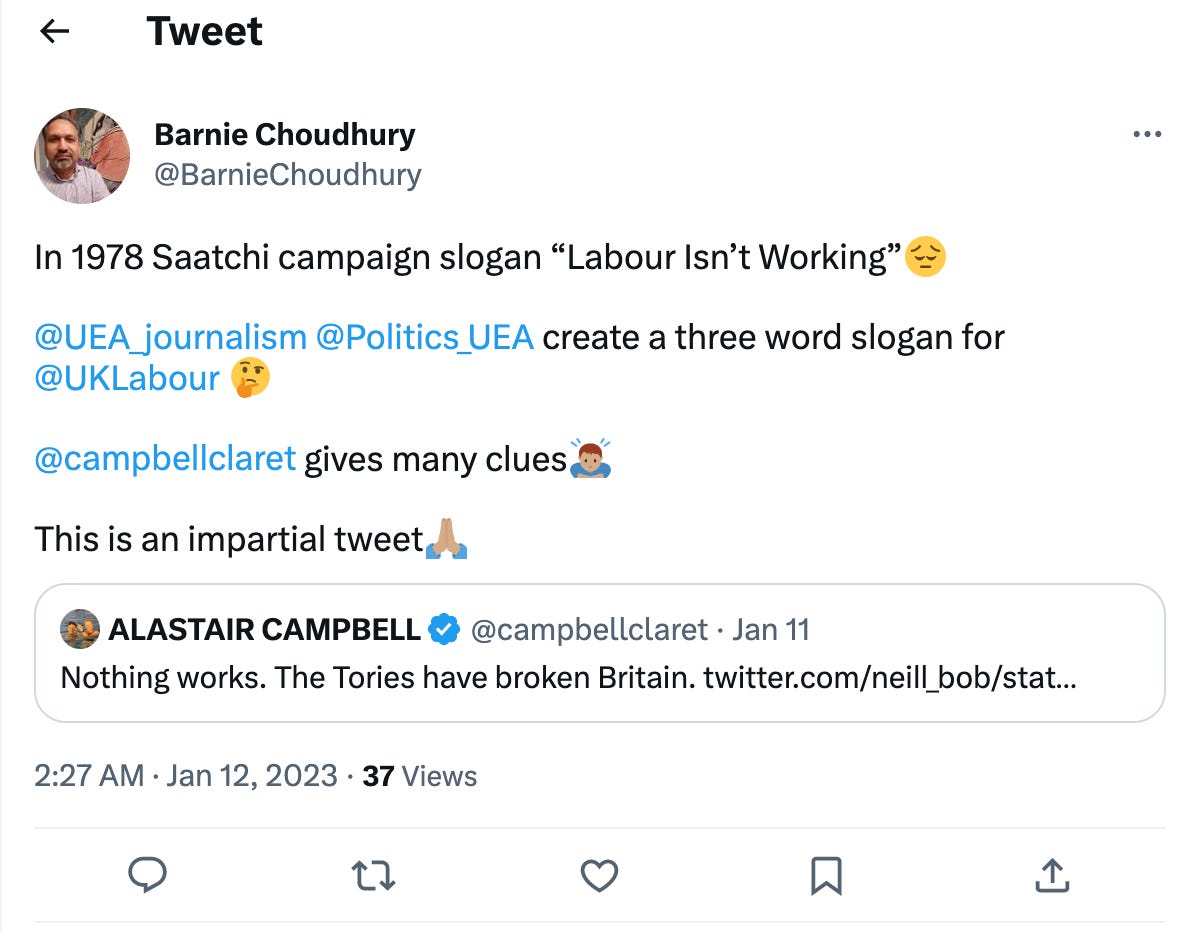
To pick a random element of today’s schedule, I can find Radio 4’s response to the religious violence between Muslims and Hindus in Leicester was to commission Playing With Fire, presented by Barnie Choudhury, which will finally ask whether Conservative MPs are actually responsible for the centuries old inter-communal strife and “whether the tactic of utilising religious divides for electoral gain has the echoes of Empire.”
We know that Barnie will be balanced, as he used his twitter feed to encourage his journalism students to create a slogan for Labour. Very witty, as you can tell.
Nigel Rees, who fronted brainbox quiz Quote, Unquote complained that he “was told that there should never be an all-white panel on panel games or quizzes.” and that he had to have disabled representation, on a panel of three, for every programme. “What has that got to do with anything? And on radio, how do you know if someone is disabled?” He also revealed to his interviewer that he was no longer able to quote the Noel Coward song, Mad Dogs and Englishman because of the colonial attitudes of the (anti-colonial) song.
Naturally, Radio 4 has its own show, Costing the Earth, dedicated to enforcing and encouraging climate hysteria. Its main criticisms of government climate policy, which is destroying our economy and will make our children poorer, is that it doesn’t go far enough.
Woman’s Hour famously now has a lot of men pretending to be women on it. You and Yours is famously the most boring programme produced in the UK. The station responded to fans of The Archers, complaining that storylines about Net Zero and installing electric vehicle chargepoints in Ambridge were actually really dull and boring, by banning them from the show’s facebook page.
It gave Rory Stewart, a bizarre former Conservative MP who set out to make the party do things extremely unpopular with its members, his own show to talk about online debate. Notably badly produced and muddled, like its presenter, the show climaxed with a peon to the bravery and poise of Ash Sarkar.
Radio 4 is aware of the threat posed to it by the new media. So, obviously, its first instinct is to attack it. It has a programme called Antisocial, dedicated to painting non-mainstream news and discussion as the domain of cranks and crackpots.
The BBC’s “disinformation” reporter, who does a valiant job of ignoring the BBC’s own disinformation when it comes to climate/energy/Covid/MRNA vaccines/Brexit/Ukraine/immigration/crime issues was given her own show to whinge about Elon Musk, a man busy putting rockets in space, not giving her an interview.
One of the worst, most egregious, aural sins happens when Radio 4 gets in the podcast game. For example, the Today presenter, Nick Robinson, has a podcast, which, rather than him interrupting and badgering his interviewees for two minutes lets you listen to him do it for an hour.
The Ratline was an attempt to do those investigative podcast series that Americans like. The first series, about Nazis on the run, was OK. The second, about a British businessman killed in China, was presented by Carrie Gracie, the BBC’s China correspondent famous for demanding to be paid the same as other journalists with more high-profile jobs. It was diabolically bad, with Gracie giggling her way through an interesting story made unbearably tedious and ending her rhetorical questions with “right?”.
As a public broadcaster, Radio 4, and the BBC generally, should not be competing with the commercial sector. It was sort of understandable when broadcasting was difficult, time consuming and expensive, but that isn’t the case anymore. Anybody can make a podcast series with a smartphone and a laptop. Why should they have to compete with the vast state-sanctioned behemoth that threatens to put you in prison if you don’t pay for it?
There are a few beacons in the dark on Radio 4. In Our Time is nearly as good as the many independent history podcasts out there, and the Moral Maze is still fascinating and thought-provoking listening - though one gets the feeling of glimpsing into a long forgotten age when public broadcasting made these sorts of programmes routinely. Perhaps it’s not surprising that the presenter on its best programme, recently complained that the BBC was getting “increasingly woke,” wokeness and talent being of course negatively correlated.
Nevertheless, sentimentality will get us nowhere. It’s got to go, all of it. I’m sure Melvyn Bragg and Michael Buerk could acquire just as large audiences outside the confines of Radio 4. Kermode and Mayo took their Radio 5 film review show onto Youtube, and zipped along to 100,000 subscribers in a few months. Mark Kermode can be quite open about his horrendously leftish politics on his show., and that’s great. Although, they’ll never hit the peaks reached by The Critical Drinker, a Scottish film reviewer who found immense digital success by recognising that mainstream film reviewers are so captured by their politics that they can no longer give an honest critical appraisal of anything.
And that’s the problem with Radio 4. It’s not honest anymore. It doesn’t represent the country because every minute of its output must be checked for adherence to ideology. An ideology that likes mass immigration, believes in climate change, believes in lockdownism, doesn’t want to lock up criminals and wants Britain culture to be so gradually eroded that what’s left of our intelligentsia demand to be subsumed into a European colony. It is morally wrong to force the population to pay for it.
It is also wrong to reward failure. So much of its output would never survive on the open market, and its presenters, writers and producers should not be given hallowed status over more talented creative professionals surviving on their wits to surf the algorithms to success. Radio 4 is successful because a lot of people, mostly the old, still cling on to their Radio 4 machines. It might well be painful for the elderly at first but, and who knows, maybe we are saving them from an earlier death brought on by the stress of an omnipresent soundscape that hates them and everything they believe.
Bury it. Salt the Earth.
Good write up.
Radio 4's output is so unbalanced. Frustratingly for those of us that would like to appear on it occasionally, its commissioners seem to have no idea how unbalanced its output is, so it remains unbalanced. Those lucky enough to be one of the BBC's chosen few are lucky to have an amazing platform.